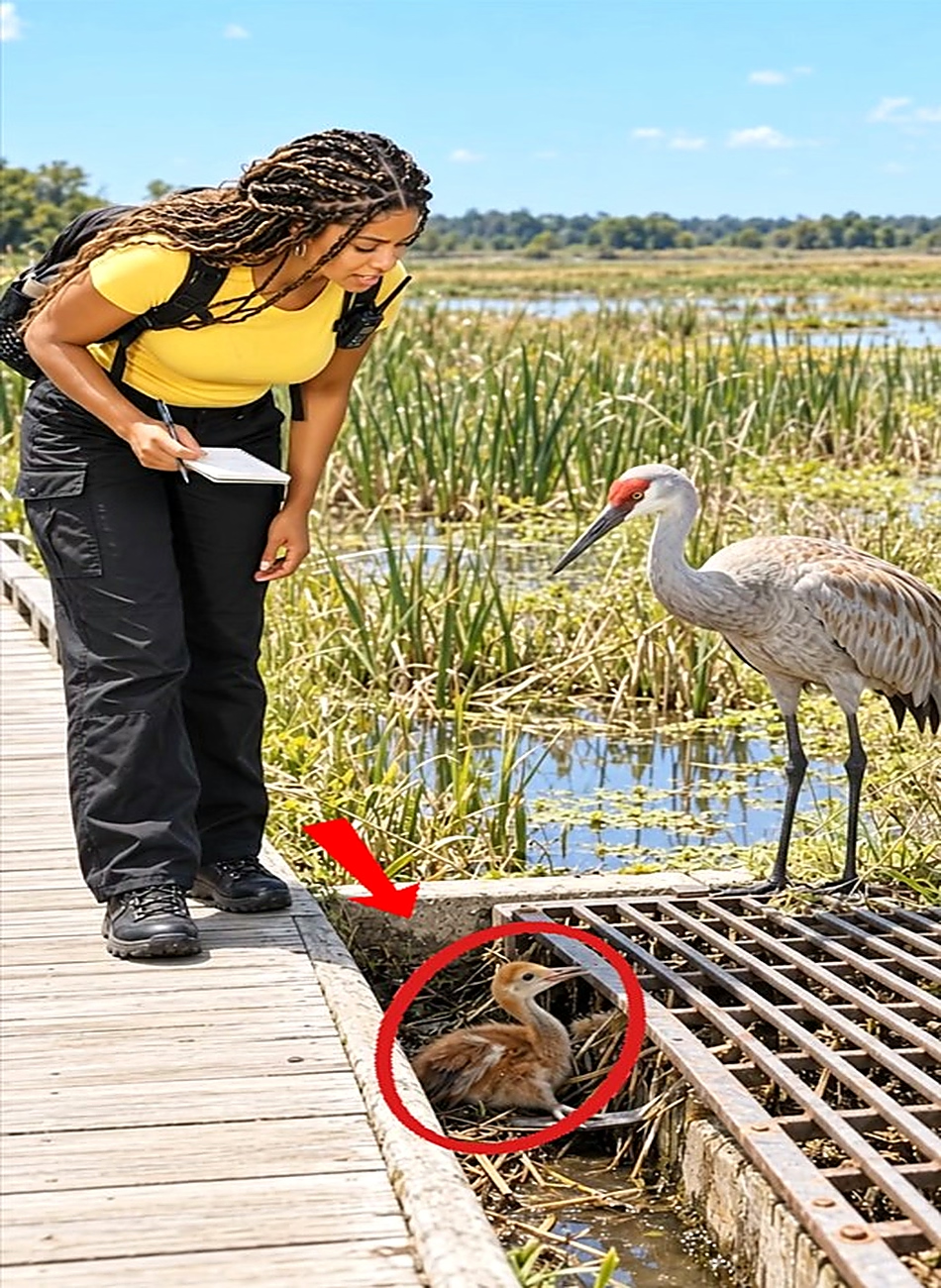
An Unusual Encounter Beside the Wetland Boardwalk
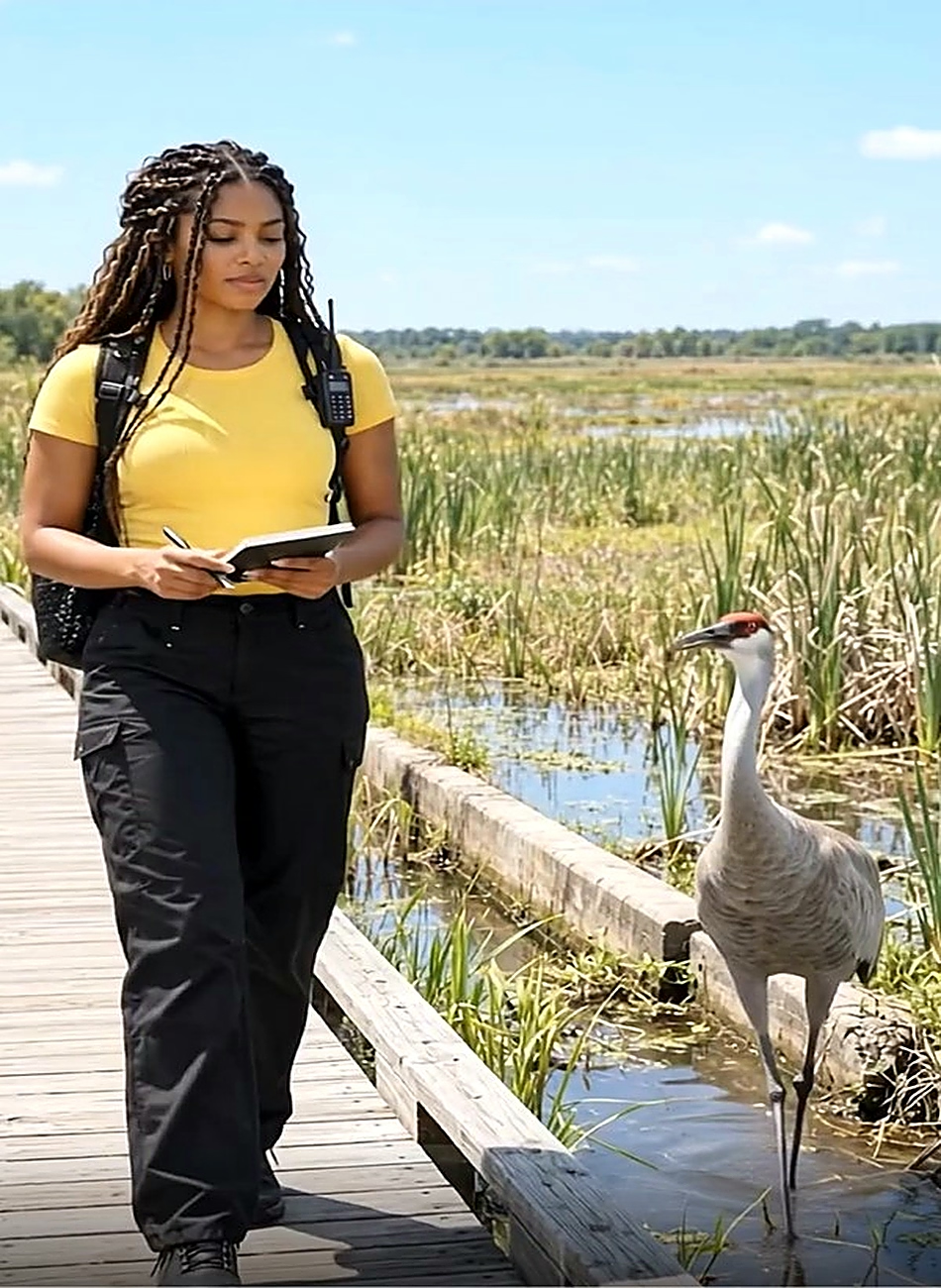
The tall gray crane stepped directly onto the wooden boardwalk, blocking the woman’s path.
Laura Mitchell stopped walking as the bird spread its wings and called repeatedly.
She had visited the wetland reserve for years but had never seen a crane behave this way.
The bird moved toward the reeds, stopped, and looked back in her direction.
When Laura remained still, it returned and called again.
Something about its repeated movements made her look beyond the railing.
Near the muddy bank, a smaller bird struggled beneath a section of damaged plastic mesh.
Laura leaned forward and recognized a crane chick trapped beside the vegetation.
The adult crane stood nearby, watching the struggling youngster.
Laura immediately reached for her phone.
She knew that approaching the frightened birds without proper equipment could make matters worse.
A Small Bird in a Dangerous Position
Laura carefully examined the area from the safety of the boardwalk.
The chick appeared to have one leg tangled inside discarded protective netting.
Its body rested against the muddy bank, just above a shallow pool.
Every attempt to move seemed to tighten the material around its leg.
The adult crane remained several yards away, calling whenever the chick struggled.
Laura suspected that the bird was one of the chick’s parents.
She had seen a pair of cranes raising young near this section of the reserve.
Earlier that spring, visitors had watched the adults guide their chicks through the reeds.
The wetland staff had placed signs asking people to remain on designated paths.
Laura understood that entering the marsh could disturb nesting birds and damage fragile vegetation.
She called the reserve’s wildlife assistance number and described what she had discovered.
The coordinator asked her to identify the nearest numbered boardwalk marker.
Laura read the marker aloud and explained that the chick was visible below the eastern railing.
She was instructed to keep her distance while a trained wildlife worker traveled to the location.
The Adult Crane Refuses to Leave
While waiting for assistance, Laura noticed that the adult crane continued moving between the reeds and boardwalk.
It approached the trapped chick, lowered its head, and then stepped backward.
The chick responded with faint calls but could not follow.
Laura watched the interaction without attempting to interpret every movement.
The adult might have been responding to the chick’s distress or simply remaining near its offspring.
Either way, its behavior had drawn her attention to the hidden problem.
A couple approaching along the boardwalk stopped when they noticed Laura watching the marsh.
She quietly explained that a young bird was trapped and that help was coming.
The visitors agreed to remain farther back to avoid disturbing the animals.
Laura also noticed that part of the plastic mesh extended beneath the shallow water.
It appeared to have broken away from an old erosion-control installation.
She photographed the material from the boardwalk so the reserve staff could identify it later.
The chick made another attempt to stand.
Its leg remained caught, and the adult crane answered with a loud call.
Laura hoped the wildlife worker would arrive before the youngster became more exhausted.
The Rescue Worker Finds Another Complication
Wildlife officer Daniel Foster arrived carrying a transport crate, protective gloves, and specialized cutting tools.
He listened as Laura explained how the adult crane had attracted her attention.
Daniel examined the chick through binoculars before approaching the bank.
He confirmed that the plastic mesh was wrapped around the youngster’s lower leg.
However, the material was also anchored beneath a partially submerged wooden stake.
Simply pulling the netting away could tighten it further.
Daniel contacted another reserve employee, Emma Reed, and requested assistance securing the area.
He explained that the adult crane might approach defensively if people moved too close.
Laura stepped farther along the boardwalk while Emma established a temporary viewing boundary.
Daniel selected a narrow maintenance path that provided safer access to the muddy bank.
He moved slowly, avoiding the deeper water beside the reeds.
The adult crane retreated several yards but continued watching.
When Daniel reached the chick, he noticed that its feathers were wet and muddy.
The youngster remained alert, although it appeared tired from struggling.
Daniel prepared to remove the mesh without placing unnecessary pressure on the trapped leg.
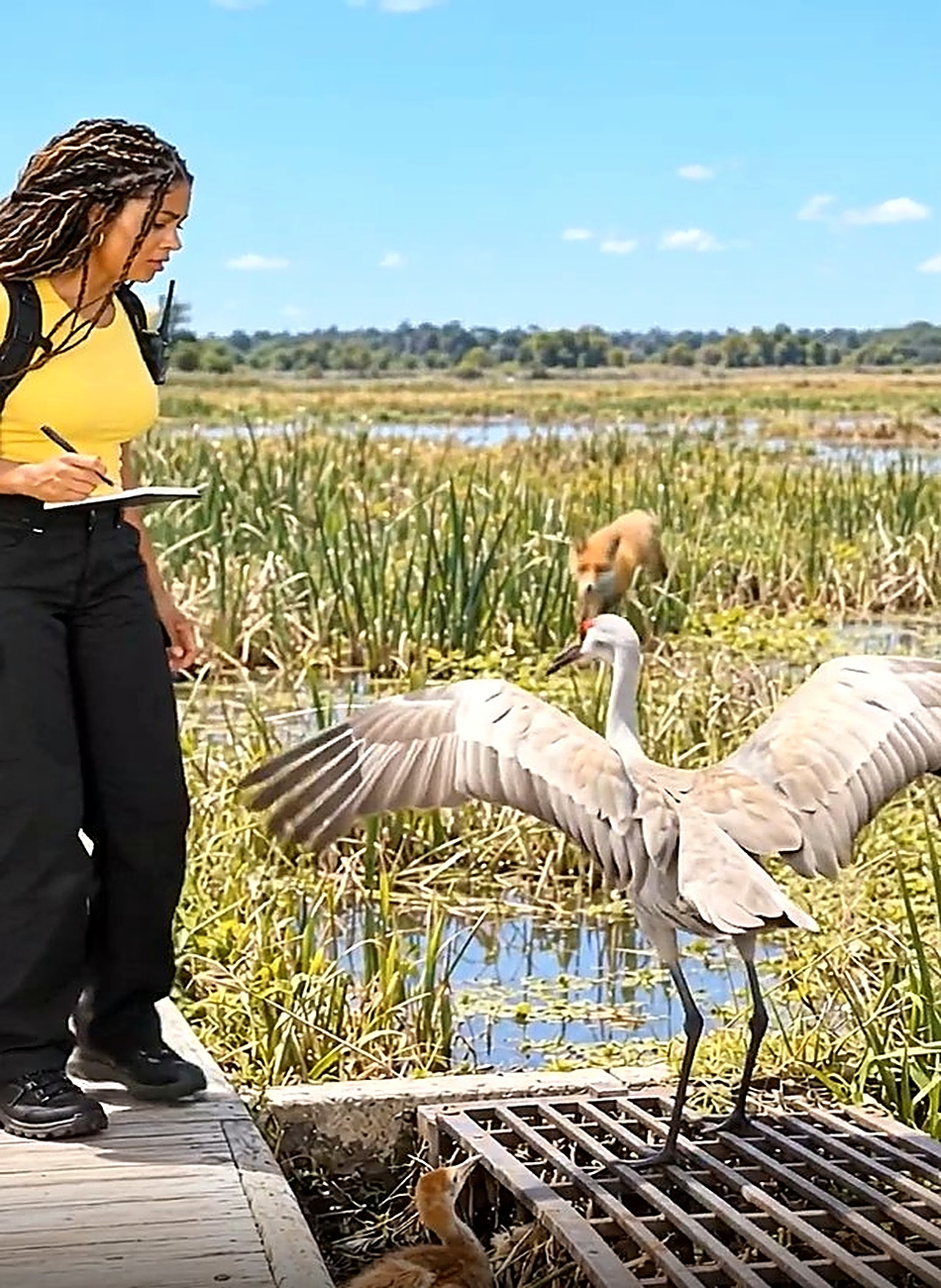
The Chick Is Finally Freed
Daniel positioned himself beside the chick and gently restrained its body with a clean towel.
He kept its wings supported while examining the tangled material.
The plastic mesh had formed several tight loops around the lower leg.
Daniel carefully cut the outer strands before working toward the section nearest the skin.
Emma monitored the adult crane from a safe distance and kept the boardwalk clear.
Laura watched quietly from behind the temporary boundary.
As Daniel separated the final strands, the chick moved its free leg.
He removed the remaining mesh and checked for visible injuries.
A shallow abrasion was present, but there was no obvious deformity.
Daniel examined the chick’s movement and decided that further assessment was necessary.
He placed the youngster inside the prepared transport crate.
The adult crane approached the edge of the reeds and called repeatedly.
Daniel explained that the chick would receive a brief veterinary assessment before any release decision.
He carried the crate along the maintenance path toward the reserve vehicle.
Laura followed at a distance, relieved that the chick was no longer trapped.
The damaged mesh was collected so it could not endanger another animal.
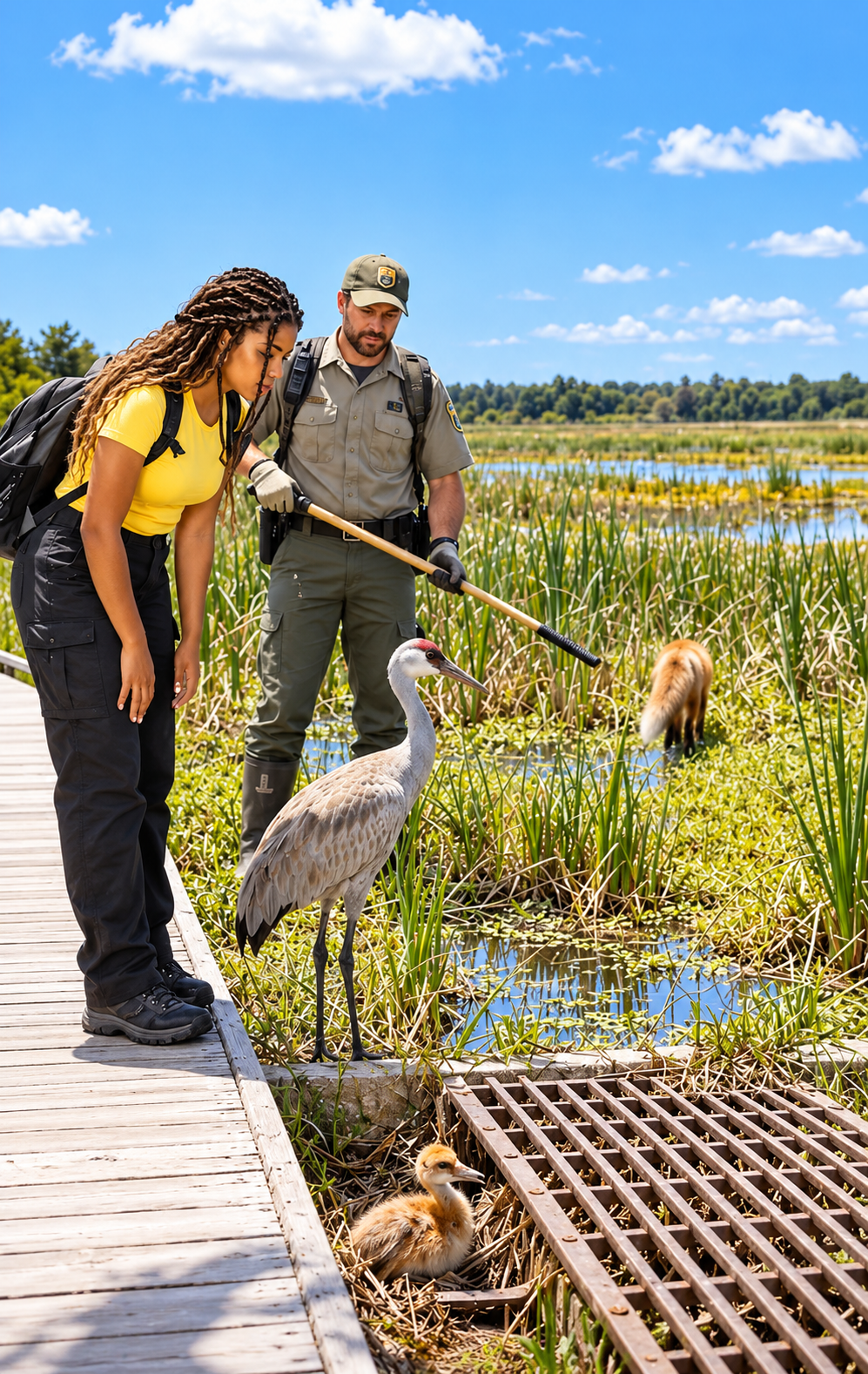
A Careful Examination Before Release
At the reserve’s wildlife care station, a veterinarian examined the young crane.
The chick was alert, and its breathing and general condition appeared stable.
The veterinarian inspected the affected leg and cleaned the superficial abrasion.
She found no obvious fracture or serious tissue damage during the examination.
However, she recommended observation to ensure the chick could stand and walk normally.
Daniel arranged a quiet holding space that minimized unnecessary handling.
The chick received appropriate supportive care while the staff monitored its condition.
By the following morning, it was standing and moving without obvious difficulty.
The veterinarian approved its return to the wetland under controlled conditions.
Daniel and Emma transported the chick to the same section of marsh where it had been discovered.
They confirmed that the adult cranes were still present nearby.
After selecting a sheltered release point, Daniel opened the transport crate.
The chick stepped onto the soft ground and paused briefly.
One adult crane called from the reeds.
The youngster responded and moved toward the sound.
Within minutes, it had joined the adult birds near the shallow water.
Daniel watched from a distance to confirm that the reunion continued without difficulty.
A Safer Boardwalk for the Birds
Several days later, Laura returned to the wetland reserve during her usual morning walk.
She noticed that workers had removed additional fragments of damaged mesh from the surrounding bank.
The reserve had also inspected nearby erosion-control materials for similar hazards.
Daniel had submitted a maintenance report recommending safer replacement materials where appropriate.
Laura stopped at the same boardwalk marker where she had first noticed the adult crane.
Across the water, she saw two adult cranes moving slowly through the reeds.
A smaller bird followed them, occasionally stopping to investigate the muddy ground.
She could not identify the chick with complete certainty from that distance.
Nevertheless, the sight reminded her of the successful release she had witnessed.
This fictional wildlife story began when an adult crane repeatedly approached a woman near a boardwalk.
Its unusual behavior drew attention to a chick trapped in discarded plastic mesh.
Laura contacted the reserve staff rather than attempting an unsafe rescue herself.
Daniel carefully freed the youngster, and a veterinarian assessed its condition before release.
The chick returned to the wetland and rejoined the adult birds.
The incident also encouraged the reserve to inspect and remove hazardous material from the area.
Laura continued visiting the boardwalk, now paying closer attention to the wildlife moving quietly beyond its railings.
For Laura, the most meaningful sight was the little crane walking freely through the reeds after a morning when it could barely move.