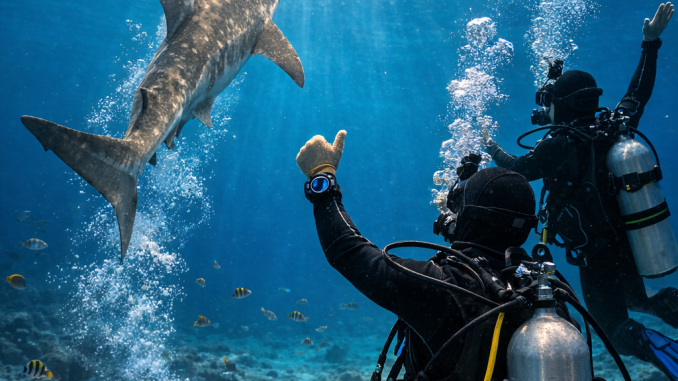
The ocean is one of the most mysterious places on Earth. Beneath its calm surface lies an entire world filled with life, beauty, and sometimes unexpected challenges.
For divers, every dive is different. Some days they encounter colorful coral reefs and schools of fish. Other days, they discover something that reminds them how fragile marine life can be.
During a routine dive in clear blue waters, two experienced divers slowly descended toward the ocean floor. Sunlight filtered through the water above them, creating soft beams that illuminated the sandy seabed.
Everything seemed calm.
But as they moved forward, something unusual caught their attention.
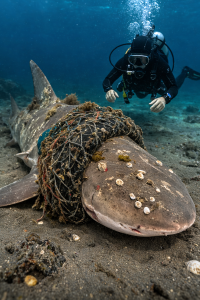
At first, it looked like a large shape covered with seaweed and ocean debris. Nets, algae, and shells appeared to be tangled together in a strange formation on the sand.
Curious, the divers approached carefully.
What they discovered surprised them.
Inside the tangled mass was a large shark.
The animal was lying on the seabed, partially wrapped in what appeared to be an abandoned fishing net — sometimes referred to as a “ghost net.” These nets are fishing nets that have been lost or discarded in the ocean, where they continue drifting and trapping marine life.
Over time, algae and marine growth had attached to the net, making it heavier and harder to escape from.
The shark had likely struggled for a long time.
The net was wrapped around its body and fins, limiting its ability to swim properly. Although the shark was still alive, it appeared exhausted from trying to free itself.
The divers paused for a moment.
Approaching any large marine animal requires caution. Sharks are powerful creatures and should always be respected in their natural habitat.
However, in this situation the shark did not appear aggressive.
It appeared trapped.
The divers exchanged signals underwater and quickly made a decision.
They were going to try to help.
Slowly and carefully, they moved closer while keeping a safe distance from the shark’s head. One diver examined how the net was wrapped around the animal’s body while the other prepared a small diving knife designed for cutting ropes or fishing lines.
The work had to be done slowly.
Fishing nets can be extremely strong, especially after they become tangled and covered with marine growth. Each cut needed to be precise to avoid causing harm to the shark.
The divers began cutting small sections of the net.
Piece by piece, the tangled material started loosening.
Small fish swam nearby as the divers worked patiently, removing sections of net that had wrapped around the shark’s body. With every piece they removed, the animal gained a little more freedom.
After several careful minutes, most of the net had been cut away.
Only a few strands remained.
The divers removed the final pieces and gently pulled the loose net away from the shark.
For a brief moment, the shark stayed still.
Then something changed.
The animal slowly moved its fins and lifted slightly from the seabed. The divers backed away to give it space, watching quietly.
With a strong movement of its tail, the shark finally swam forward.
Free.
It moved calmly through the blue water, gradually disappearing into the vast ocean.
The divers remained in place for a moment, observing as the powerful animal returned to its natural environment.
Encounters like this highlight an important reality about our oceans.
Lost fishing gear can remain in the water for years, sometimes trapping fish, turtles, sharks, and other marine animals. These ghost nets are one of the many environmental challenges affecting ocean ecosystems.
At the same time, moments like this also show how awareness and responsible actions can make a difference.
The ocean is home to countless species, many of which rely on a balanced and healthy environment to survive.
And sometimes, a small act of care can give a powerful creature another chance to continue its journey through the sea.
Stories like this remind us that the ocean still holds incredible moments — and that protecting marine life is something that benefits the entire planet.