On the edge of an industrial lot, where gravel meets rusted fencing and old warehouses block the horizon, the wind rarely stops blowing.
Dust rolls across the ground in thin waves. Plastic scraps cling to metal poles. It is not a place meant for comfort. It is not a place meant for shelter.
And yet, near the fence line, a makeshift structure stood.
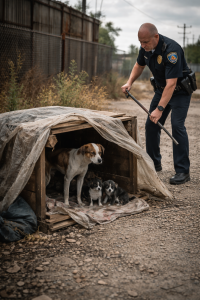
It was built from plastic sheets, uneven wooden scraps, and pieces of discarded material tied together with wire. Inside that fragile cover lay a mother dog and her small puppies, pressed closely together against the cold ground.
It wasn’t much.
But it was theirs.
The sky hung low and grey when an older police officer stepped into the lot. His boots crunched against the gravel as he approached the shelter. In his hand, he carried a crowbar.
From a distance, the scene didn’t look promising.
The officer stopped in front of the structure and examined it carefully. The plastic sheets flapped wildly in the wind. One side of the wood frame had already begun to split. Nails were sticking out unevenly. The entire thing leaned slightly, unstable.
He placed the crowbar under one side and lifted.
The structure shifted.
Inside, the mother dog stood immediately — alert, tense, protective. Her body positioned itself between the puppies and the open side of the shelter.
From that angle, the moment looked harsh.
It looked like someone was tearing down the only protection they had.
The officer pulled apart the unstable wooden scraps. The weak frame gave way faster than expected. Plastic sheets slid to the ground. The wind carried a torn edge several feet away.
The puppies huddled together instinctively.
The mother dog did not lunge. She did not attack.
She simply watched.
Carefully.
Within minutes, the fragile structure was reduced to scattered debris across the gravel. The exposed space felt colder without it. The sky seemed heavier.
The officer gathered the loose pieces and moved them aside. He didn’t rush. He didn’t speak. He worked with quiet focus.
When he was done, nothing remained of the old shelter.
Only open ground.
From the outside, it appeared heartless.
The officer walked toward a large utility vehicle parked near the warehouse and drove away.
The mother dog remained where she was, sitting protectively near her puppies under the grey sky.
For a while, nothing moved except the wind.
Time passed.
Clouds shifted slowly overhead.
Then, in the distance, the sound of an engine returned.
The officer drove back into the lot, this time operating a small flatbed utility cart. Secured on the back was something entirely different from what had stood there before.
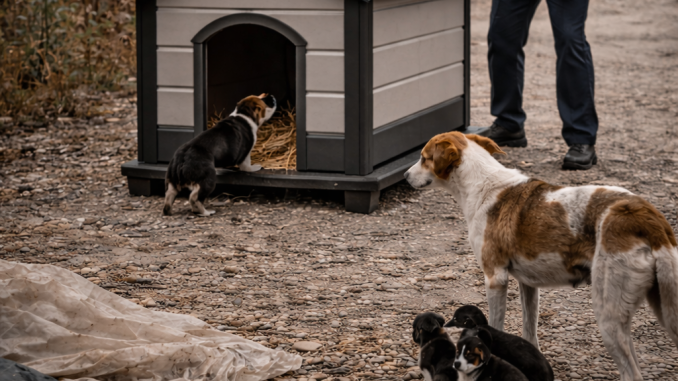
It was a large insulated kennel, built from solid weatherproof composite panels. The material was sturdy and clean. The structure was elevated slightly off the ground to prevent moisture from seeping in. Its entrance was wide but shielded. Its roof was sealed and stable.
Not scrap wood.
Not plastic sheets.
Something built to last.
He parked near the cleared space and carefully unloaded the kennel onto a leveled section of gravel. He adjusted its position slightly, ensuring it sat evenly and securely.
Then he opened the entrance and placed fresh straw bedding inside — thick, clean, and dry.
He stepped back slowly.
The mother dog observed everything from a short distance away. Her posture was still alert, but no longer tense. She watched, assessing.
The officer moved farther away, giving space.
One of the puppies took a cautious step forward.
It sniffed the air.
Then it walked toward the new structure.
It paused at the entrance, nose close to the threshold.
After a moment of hesitation, it stepped inside.
The other puppies followed.
The mother dog remained outside briefly, watching them enter.
Then she approached.
She sniffed the straw, inspected the walls, and stepped inside after them.
The wind continued blowing across the lot, but the kennel did not move.
Later that day, a faint warmth broke through the clouds. Light touched the gravel in softer tones. The industrial lot still looked rough and unfinished, but one small space within it felt different.
All the puppies were inside the new kennel, nestled into the straw bedding.
The mother dog sat at the entrance, calmer now. Not defensive. Not anxious. Simply present.
The officer stood near his vehicle for a moment — not posing, not seeking attention. He looked toward the kennel briefly, then returned to his cart.
The old debris was gone.
The ground was cleaner.
The space was safer.
What had looked like destruction was, in reality, replacement.
The fragile shelter had never been stable. One strong gust of wind could have collapsed it. Exposed nails and sharp edges had posed hidden risks. The plastic sheets offered little protection from rain or cold air.
Sometimes improvement begins by removing what no longer works.
From the outside, change can look harsh. It can look abrupt. It can even look uncaring.
But not every act is what it seems in the first moment.
In that quiet industrial lot, under a sky that had started the day grey and heavy, something stronger now stood in place of something fragile.
The mother dog rested.
The puppies slept.
And the wind continued to move across the gravel — no longer cutting through torn plastic, but passing quietly over a shelter built to last.
Not everything that falls is a loss.
Sometimes, it is simply the first step toward something better.