The morning sky over the coastline was gray and calm. Gentle waves rolled onto the shore while the sound of seabirds echoed over the water. At first glance, it looked like an ordinary day along the beach.
But there was one painful difference.
The shoreline was covered in trash.
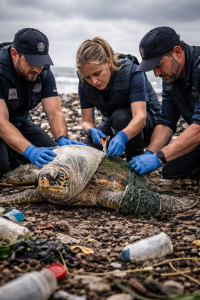
Plastic bottles, torn fishing nets, pieces of packaging, and old containers were scattered across the rocks and sand. With every tide, the ocean seemed to bring more debris back to the land. It was a quiet reminder of a growing global problem that many people only notice when it becomes impossible to ignore.
That morning, a small marine rescue team was walking along the beach during a routine environmental inspection. Their goal was simple: monitor the coastline and remove dangerous debris that could harm wildlife.
They had done this many times before.
Unfortunately, they knew that ocean animals often become victims of plastic waste.
But what they were about to find would stay with them for a long time.
As one of the rescuers scanned the shoreline, something unusual caught his attention.
At first, it looked like a large object tangled in seaweed and trash. From a distance, it could easily have been another piece of floating debris washed ashore.
But when the team moved closer, they suddenly realized what it actually was.
A sea turtle.
The large turtle was barely moving. A torn plastic bag was wrapped tightly around its head, and a thick fishing net was tangled around one of its flippers. Pieces of plastic were stuck along its shell, and debris surrounded its body.
It had likely been struggling for hours.
Maybe even days.
Sea turtles are strong swimmers, but when they become trapped in plastic waste, even the strongest animals can become helpless.
The rescue team moved quickly but carefully.
Wild animals under stress can easily become frightened or injured further if handled incorrectly. The rescuers approached slowly, speaking softly and keeping their movements calm.
One team member gently held the turtle steady while another examined the fishing net wrapped around its flipper.
The net was tight.
Very tight.
It had already begun pressing into the turtle’s skin.
Using specialized rescue scissors, one of the workers carefully began cutting the net away. Each small cut had to be precise. Pulling too hard could cause more harm than good.
Piece by piece, the tangled strands began to loosen.
Meanwhile, another rescuer worked on the plastic bag wrapped around the turtle’s head. The bag had become stuck because of seawater and sand.
Slowly, and with great care, they removed it.
The moment the plastic came free, the turtle lifted its head slightly.
It was a small movement, but it was enough to tell everyone something important.
The turtle was still fighting.
Encouraged by this sign, the team continued working. They removed every remaining piece of fishing line and plastic that had become wrapped around the animal.
What remained was a turtle covered in sand, algae, and bits of debris.
The next step was just as important.
Cleaning.
One of the rescuers brought over a container of clean water. Using gentle brushes and their hands, the team began washing away the dirt and plastic fragments stuck to the turtle’s shell.
Water flowed across the turtle’s back and flippers, slowly revealing its natural colors again.
The turtle blinked slowly as the water ran over its shell.
For the first time since they arrived, it seemed calm.
After checking carefully to make sure there were no remaining pieces of net or plastic, the team prepared for the final step.
Returning the turtle to the ocean.
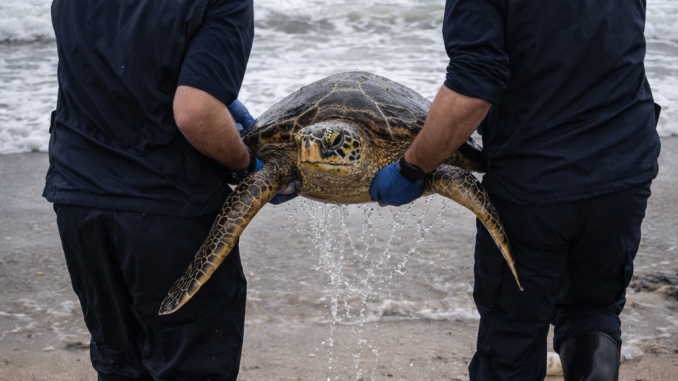
Two rescuers carefully lifted the animal. Even though sea turtles appear heavy and solid, they must be handled gently to avoid injury.
Step by step, they walked toward the shoreline.
The waves rolled softly onto the sand as they approached the water.
When the rescuers reached the edge of the sea, they lowered the turtle carefully into the shallow surf.
For a moment, the turtle stayed still.
As if it needed time to understand that it was free again.
Then something beautiful happened.
The turtle slowly moved its flippers.
Once.
Then again.
The ocean carried it forward, and within seconds it began swimming away into deeper water.
The rescue team stood quietly on the shore watching.
Moments like this are why marine rescue workers dedicate their time to protecting wildlife. Each successful rescue represents more than just saving a single animal.
It represents hope.
Sea turtles are ancient creatures. They have lived in Earth’s oceans for more than 100 million years, surviving massive changes in the planet’s climate and ecosystems.
Yet today, one of their greatest threats is something that did not exist until recently.
Plastic pollution.
Every year, millions of tons of plastic waste enter the world’s oceans. Many marine animals mistake plastic for food, while others become entangled in discarded fishing nets or packaging.
For sea turtles, plastic bags can look like jellyfish — one of their natural food sources.
When they try to eat it, the consequences can be deadly.
That is why small actions from people around the world can make a big difference.
Reducing plastic use.
Disposing of waste responsibly.
Supporting ocean conservation.
Each of these steps helps protect the fragile ecosystems that countless animals depend on.
The rescue team eventually left the beach later that afternoon, continuing their work along the coastline.
Behind them, the waves continued rolling onto the shore.
Somewhere beneath the surface of the ocean, the sea turtle they rescued was already swimming freely again.
Back where it belonged.
And for the people who witnessed that moment, the memory would serve as a powerful reminder.
Even in a world facing serious environmental challenges, compassion and action can still change the outcome of a life.
Sometimes, all it takes is someone choosing to stop… look closer… and help.