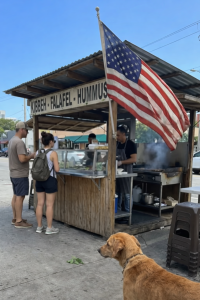
Every afternoon, on a quiet neighborhood corner, a small wooden food stand filled the air with the smell of grilled kibbeh and warm bread. People came and went, placing their orders, pulling green bills from their wallets, and exchanging them for food.
Not far from the stand, a thin golden-brown stray dog watched the routine carefully.
He never barked.
He never begged.
He just observed.
Day after day, he saw the same pattern. A customer would hand over something green. The vendor would smile, place it inside his wallet, and then give them food. The dog didn’t understand money. He didn’t know numbers or value.
But he noticed one detail.
The payment was green.
One afternoon, after watching another exchange, the dog quietly walked toward a nearby tree. A fresh green leaf had fallen onto the sidewalk. He lowered his head, picked it up gently, and turned back toward the stand.
People barely noticed.
The vendor did.
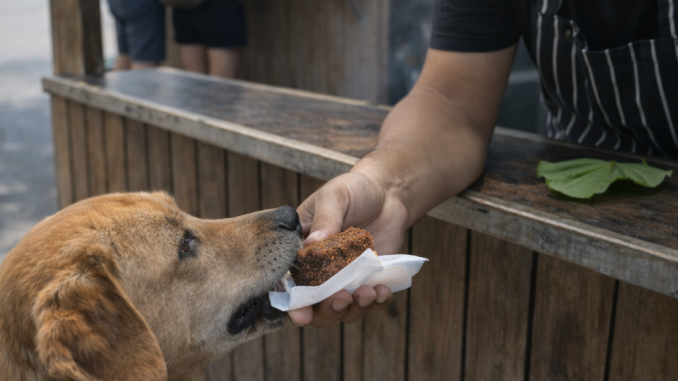
The dog approached the counter and carefully placed the leaf near the edge. He stood there, calm and hopeful, eyes lifted — not demanding, just waiting.
For a second, the vendor looked confused.
Then he understood.
Without hesitation, he reached for a fresh piece of kibbeh, wrapped it in a napkin, and leaned down to offer it to the dog. The dog accepted it softly and stepped aside to eat.
There was no applause.
No cameras.
Just a quiet moment between two beings who didn’t share a language — but understood each other perfectly.
Later that day, when the rush slowed down, the vendor picked up the leaf. Instead of throwing it away, he opened his worn leather wallet and slid it carefully between real dollar bills.
Among all the money he had earned that day, the leaf stood out.
Not because of its value.
But because of what it represented.
Trust.
Innocence.
A simple attempt to participate in the world as it works.
The vendor kept that leaf in his wallet long after it dried.
Because sometimes, the greatest payment isn’t made with money.
It’s made with heart.