It wasn’t a dramatic afternoon.
There were no raised voices, no flashing lights, no crowd forming on the sidewalk. It was just another ordinary day in a busy American city. Cars moved steadily through the intersection. People walked past with coffee cups in hand, focused on work, errands, and notifications lighting up their screens.
Near a public trash bin on the corner of the street, a woman in worn, layered clothing searched quietly through discarded bags.
She wasn’t asking anyone for money.
She wasn’t disturbing anyone.
She was simply hungry.
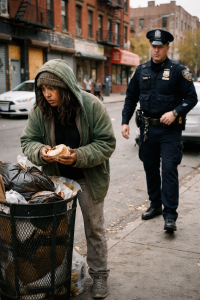
After a few moments, she found half a loaf of bread wrapped loosely in paper. It wasn’t fresh, but it was something. She held it carefully, almost protectively, as if it might disappear if she let go.
For a brief second, relief crossed her face.
Then she heard a voice behind her.
“Ma’am, step away from that.”
A police officer had approached from the sidewalk. His patrol car was parked a short distance away. His tone was firm, professional — the kind of voice used to maintain order in public spaces.
The woman froze.
She turned slowly, still holding the bread.
“I’m sorry,” she said quietly. “I was just hungry.”
The officer kept his posture straight. “You can’t take food out of the trash. Please step away from the bin.”
There was no shouting. No anger. Just authority.
People walked by. A few glanced at the scene, then continued on their way.
Slowly, she lowered her hands and placed the bread back inside the trash bin.
Her shoulders dropped.
Hunger is difficult. But humiliation can feel heavier.
She stepped back and sat down on the curb, pulling her jacket tighter around her. She kept her eyes on the ground.
For her, it probably felt like the end of the story.
But it wasn’t.
The officer remained standing there for a moment. He looked at her — not as a problem, not as a disturbance, but as a person sitting on cold pavement with nowhere else to turn.
Then he turned and walked away.
From her perspective, he was leaving.
Another reminder that rules come first.
Another reminder that survival often comes quietly, and sometimes painfully.
But instead of getting into his patrol car, the officer crossed the street.
He entered a small neighborhood grocery store.
Inside, shelves were stocked with fresh bread, fruit, bottled water, and packaged meals. The store was warm, bright, ordinary — the kind of place people walk into every day without thinking twice.
The officer picked up a loaf of fresh bread.
Then apples.
Then bottled water.
He added a sandwich and a few packaged snacks.
Nothing dramatic. Nothing symbolic. Just food.
He paid at the counter and walked back outside.
The woman was still sitting near the trash bin, staring at the pavement.
When he approached, she looked up again — unsure what to expect.
His tone was different now. Calm. Measured.
“You don’t need to eat from the trash,” he said.
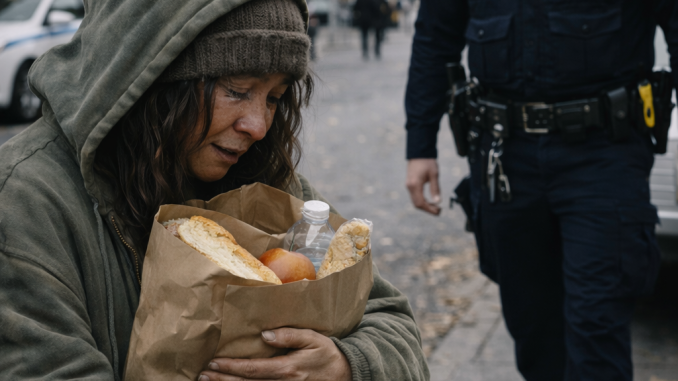
He lowered the grocery bags toward her.
She blinked, confused.
“For me?”
“Yes.”
There was no lecture. No speech. No explanation about policy or procedure.
Just a simple gesture.
She hesitated before taking the bags. When she looked inside, she saw fresh bread. Clean bottled water. Fruit. Food meant to be eaten.
Her hands trembled slightly.
“Thank you,” she said softly.
The officer gave a small nod. “Next time, ask for help.”
There was no judgment in his voice.
Only steadiness.
He stepped back and allowed her space. He didn’t wait for attention. He didn’t look around to see who was watching.
He simply returned to his patrol car.
The city kept moving.
Traffic continued. Store doors opened and closed. People passed by, unaware of what had just happened a few feet from where they walked.
But something had changed for one person.
She no longer had to choose between hunger and embarrassment that afternoon.
In conversations about community support, public safety, and social challenges, discussions often center around systems, funding, and policy. Those conversations matter. They are important.
But individual moments matter too.
Human kindness does not always arrive wrapped in soft words. Sometimes it begins with a rule. Sometimes it begins with correction.
What matters is what comes next.
Authority and compassion do not have to be opposites. In many situations, they can exist together.
The officer could have walked away after enforcing the rule. He would have fulfilled his responsibility. No one would have questioned it.
Instead, he addressed the real issue.
Not the bread.
The hunger.
For someone facing difficult circumstances, dignity can be as important as food. Being seen as a person — not as a problem — can restore something deeper than a meal ever could.
There were no cameras capturing the exchange.
No headlines were written.
No viral video appeared online.
It was a quiet act.
But quiet acts still matter.
Every day, across cities and towns, small moments unfold that never make the news. A door held open. A meal shared. A conversation that offers respect instead of dismissal.
They don’t always change the world.
But they can change someone’s day.
And sometimes, that’s enough.
Compassion does not require perfection. It does not require grand gestures. It does not require applause.
It requires awareness.
It requires pausing long enough to see the person standing in front of you.
That afternoon, one officer chose to pause.
One woman received more than food.
She received dignity.
And in a world that often moves too fast to notice quiet struggles, that small decision carried more weight than anyone passing by could have imagined.
Sometimes kindness is loud.
Sometimes it is subtle.
And sometimes it begins with “step away” — and ends with “here.”