Midday sunlight stretched across open countryside near a wide sunflower field. The sky was clear, bright, almost peaceful. A gentle breeze moved through the tall grass, bending it in soft waves.
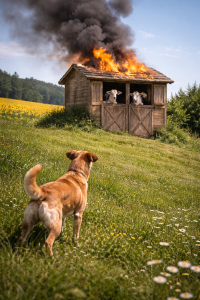
On a small hill overlooking the field stood a simple wooden goat shed.
It wasn’t large. Just a modest structure with dry wooden shingles and a half-door at the front. It had likely stood there for years, weathered by sun and wind but still serving its purpose.
Then smoke began to rise.
At first, it was thin and almost easy to miss — a faint gray trail curling upward from the roofline. But within moments, it thickened. The dry shingles caught quickly, and small flames began to crawl across the surface.
Inside the shed, two white goats paced nervously.
They pressed against the open window spaces, bleating in confusion. The half-door at the front remained closed, and the latch had warped slightly from heat. Smoke began filling the interior.
Down in the field below, a medium-sized brown rescue dog lifted his head.
He noticed it before anyone else did.
He froze for half a second, staring toward the hill. His ears perked. His body stiffened.
Then he ran.
Without hesitation, he bolted uphill, paws kicking up dust and grass. He didn’t slow down. He didn’t circle. He moved with clear purpose.
Halfway up the hill, he changed direction.
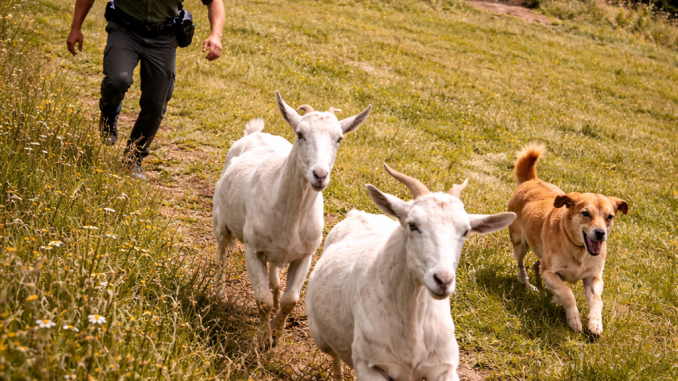
Instead of going straight to the shed, he veered toward an irrigation canal where a young wildlife ranger was repairing a section of fence. The ranger, in his early 30s, wore a green uniform and work gloves, focused on tightening wire along a wooden post.
The dog barked sharply.
Not playful. Not casual.
Urgent.
He circled the ranger once, barked again, then sprinted back toward the hill.
The ranger paused.
He looked up.
That’s when he saw the smoke.
His expression changed instantly.
He dropped his tools and ran.
The shed was burning more intensely now. Flames had spread across part of the roof, and thick smoke poured upward into the bright blue sky. Heat shimmered in the air around the structure.
Inside, the goats pressed against the half-door, pushing but unable to open it.
The ranger reached the shed and grabbed the latch.
It didn’t move.
The wood had expanded from heat. The latch was jammed.
The dog jumped against the door, barking rapidly.
The ranger looked around quickly and spotted a metal shovel leaning against a fence post nearby. He grabbed it and struck the latch hard.
Once.
The wood cracked.
He struck again.
The latch gave way.
The door swung open.
A rush of hot air burst outward, carrying smoke with it. For a moment, the goats hesitated at the threshold, overwhelmed by the sudden light and open space.
The dog stepped forward first.
He barked sharply — not aggressive, not threatening — but commanding movement.
One goat bolted past him.
Then the second followed.
They stumbled briefly onto the grass before regaining balance and running downhill.
The ranger stepped aside, guiding them away from the structure and toward open space. Flames now licked the inner beams of the shed, and the roof began to weaken.
The dog ran alongside the goats, staying just behind them, keeping them moving forward instead of turning back in confusion.
They moved quickly across the field.
Behind them, the small wooden shed collapsed inward with a sharp crack, sending sparks and smoke upward into the clear sky.
Black smoke rose high above the hill, but the danger zone was behind them now.
The goats continued running until they reached the lower meadow near a line of trees. There, the ranger slowed them down, gently steering them into open grass away from dry brush.
They stopped.
Breathing hard.
But unharmed.
The dog stood beside them, panting, watching closely.
The ranger bent forward, hands on his knees, catching his breath. Sweat mixed with dust on his forehead. He looked back toward the hill where smoke still drifted upward.
The shed was gone.
But the goats were safe.
The dog sat beside him, chest rising and falling rapidly.
One of the goats stepped closer.
It nudged the dog gently with its nose.
Not in fear.
Not in confusion.
But in quiet recognition.
The ranger straightened slowly and placed a hand on the dog’s head. There was no dramatic celebration. No raised voices. Just relief.
The sky remained clear. The sun continued shining over the sunflower field as if nothing had happened.
But something had changed.
What began as a thin line of smoke on the horizon could have ended very differently.
It could have been too late.
It could have been unnoticed.
Instead, it was a moment defined by awareness — and action.
The dog didn’t wait.
He didn’t hesitate.
He saw the smoke and ran.
Sometimes, courage doesn’t look loud or heroic. Sometimes, it looks like instinct. Like loyalty. Like movement without doubt.
In the wide open countryside, under a sky that had started the day calm and bright, a small chain of events unfolded quickly.
Smoke.
A bark.
A sprint uphill.
A broken latch.
An open door.
And then, open fields and second chances.
By late afternoon, the meadow felt peaceful again.
The goats grazed slowly near the tree line.
The ranger gathered his tools.
The brown rescue dog lay in the grass, resting but alert, ears still tuned to every sound.
What started as smoke rising from a small wooden shed ended not in loss — but in movement, coordination, and a reminder that sometimes the first to notice makes all the difference.
The danger had passed.
The sky was clear.
And in the quiet of the countryside, life continued — steady, breathing, and safe.