It was an ordinary afternoon inside a busy supermarket. Fluorescent lights reflected off polished floors, carts rolled through the aisles, and people focused on their shopping lists without much attention to anything else.

In one of the hygiene aisles, an elderly woman sat quietly in her wheelchair. Her short gray hair framed a tired but dignified face. She wore a light cardigan and held a small folded shopping list in her hand.
She needed a package from the top shelf.
She stretched her arm as far as she could. Her fingers brushed the corner of the item, but it stayed out of reach. She tried again, this time using her shopping list to pull it closer. It didn’t work. The product shifted slightly, then settled back into place.
A few people passed by. No one stopped.
Her face tightened—not from anger, but from frustration. Losing independence in small moments like this can feel heavier than it looks. She leaned back into her chair and exhaled.
A few steps away, a young man noticed.
He was holding a small shopping basket. He didn’t rush over. He didn’t stare. He simply observed for a moment, making sure she truly needed help and wasn’t just browsing.
Then he walked toward her.
Without making a scene, he reached up and grabbed the package from the top shelf. He handed it to her with a calm smile.
She looked up at him, surprised.
“Thank you,” she said softly.
He nodded. “Of course.”
As he glanced at her list, he noticed there were a few more items placed high on different shelves. Cereal. Cleaning spray. A few essentials she clearly needed.
“Would you like help with the rest?” he asked.
She hesitated for a second, then nodded.
He moved down the aisle, collecting each item carefully, placing them in his basket as if it were the most normal thing in the world. No dramatic gestures. No attention-seeking behavior. Just quiet assistance.
At the checkout, he placed all her items on the counter.
When the cashier finished scanning, the elderly woman reached for her purse.
Before she could take out her wallet, the young man gently handed his card to the cashier.
She looked at him, confused.
“You don’t have to—” she began.
“I know,” he replied calmly. “I want to.”
There was no pity in his voice. No superiority. Just respect.
A few people standing in line watched silently. The moment wasn’t loud, but it was powerful.
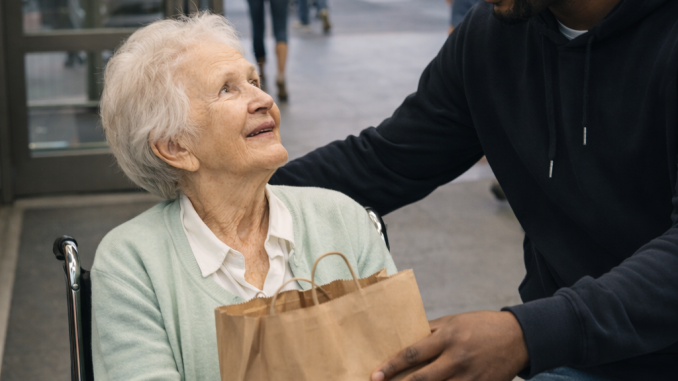
After paying, he placed the grocery bag carefully on her lap near the exit doors. Evening light filtered through the glass entrance, casting a soft glow around them.
She looked up at him again, her eyes slightly moist but steady.
“Thank you,” she repeated.
He smiled. “Take care.”
Then he walked away, blending back into the rhythm of the store as if nothing extraordinary had happened.
But for her, it had.
Sometimes respect isn’t about grand speeches or public praise.
Sometimes it’s about noticing someone’s struggle — and choosing to help without being asked.
And in a world where many people walk past, that choice matters.