It was a quiet autumn afternoon on a narrow rural road surrounded by tall pine trees and scattered yellow leaves. The sky was cloudy, and a gentle wind moved through the forest, carrying the calm silence that often fills countryside roads.
Cars passed occasionally, their engines fading quickly into the distance as they continued along the highway.
To most drivers, the road looked perfectly ordinary.
But on the gravel shoulder beside the asphalt, something tragic was unfolding.
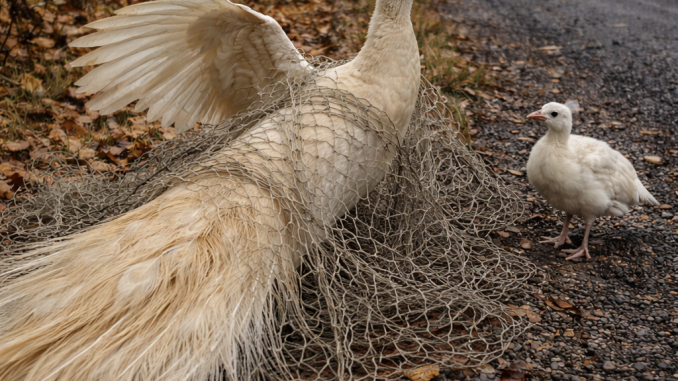
A beautiful white peacock had become trapped.
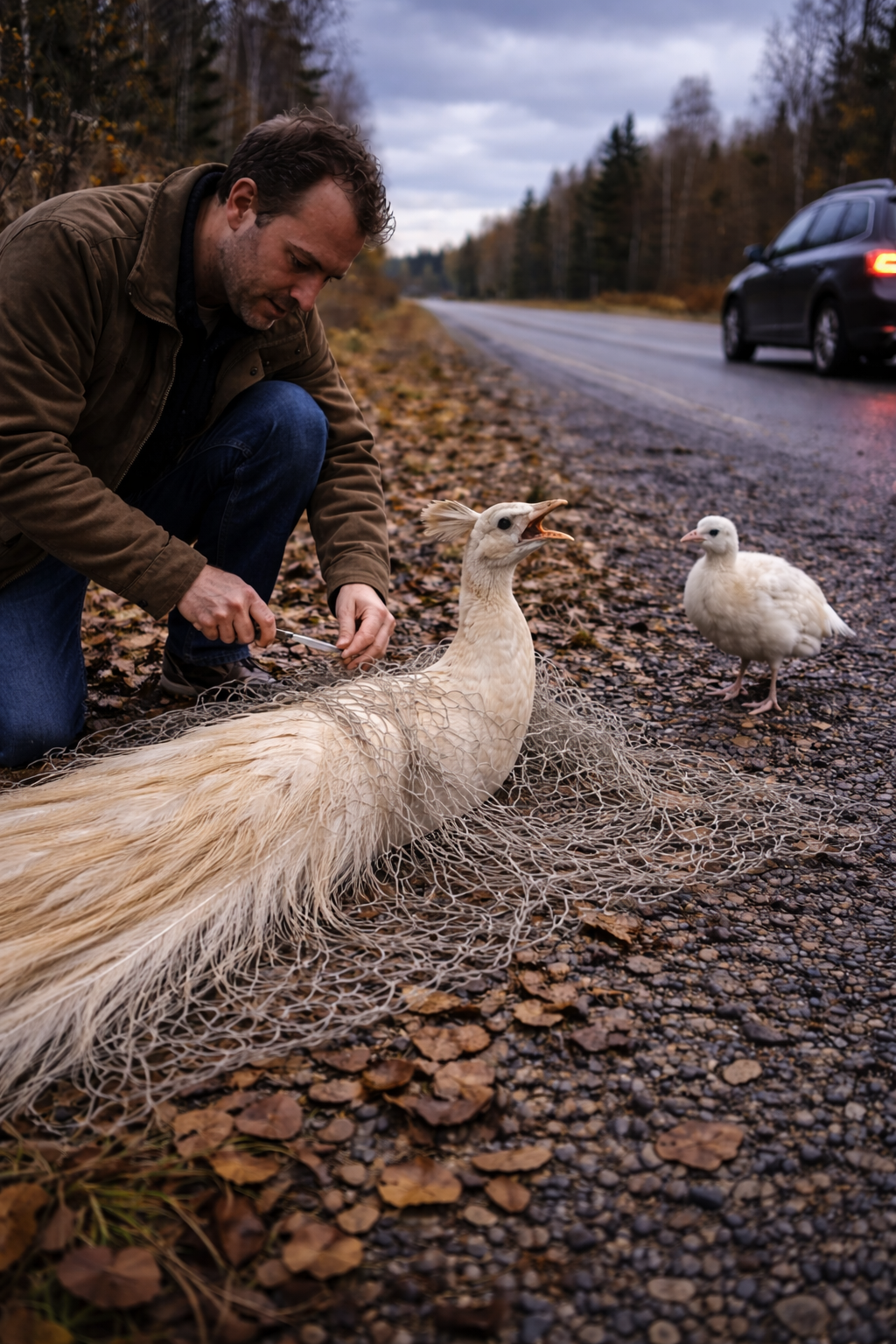
The large bird was tangled tightly in an old fishing net that had been thrown away near the roadside. Its long elegant tail feathers were wrapped in the net, preventing the bird from moving freely.
Every time the peacock tried to flap its wings, the net tightened even more.
The bird struggled desperately.
Its wings beat against the gravel as it tried to free itself.
But the more it fought, the more trapped it became.
Beside the helpless bird stood a tiny peacock chick.
The small chick chirped loudly, pacing nervously around the trapped parent.
It didn’t understand what had happened.
All it knew was that something was terribly wrong.
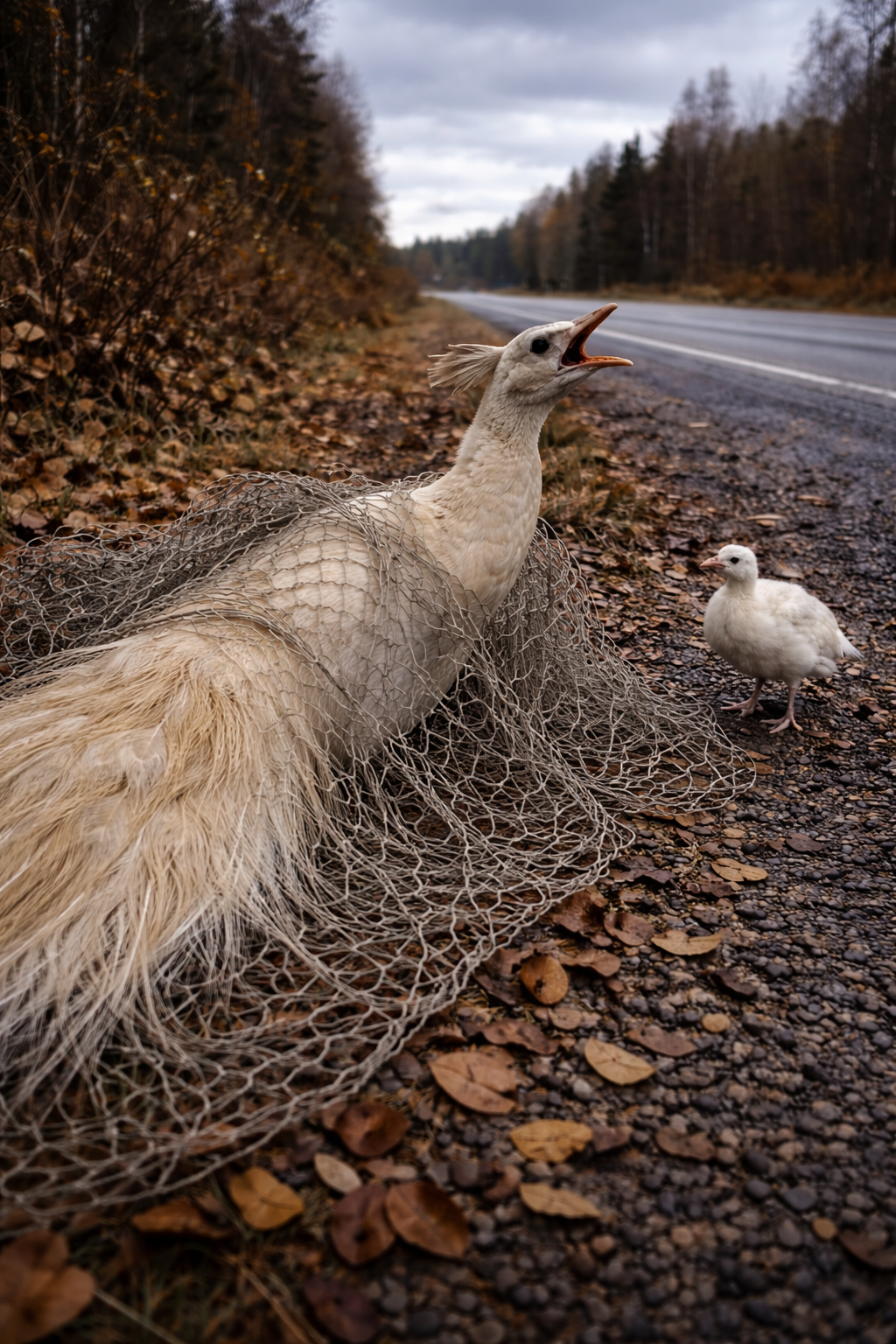
The chick kept calling out while the peacock lifted its head and cried for help.
The sound echoed softly through the forest.
But the road remained quiet.
A few cars passed by, their drivers focused on their destinations.
From a distance, the trapped bird might have looked like nothing more than debris on the roadside.
Most people simply didn’t notice.
The fishing net had likely been discarded carelessly by someone who never imagined it could cause harm.
Yet for this peacock, that piece of trash had become a dangerous trap.
The bird’s feathers were dirty from the gravel, and it was beginning to show signs of exhaustion.
The chick circled closer and closer, chirping anxiously as if begging someone — anyone — to help.
But minutes passed.
And no one stopped.
The quiet forest road stretched endlessly ahead, disappearing between the tall trees.
Then something changed.
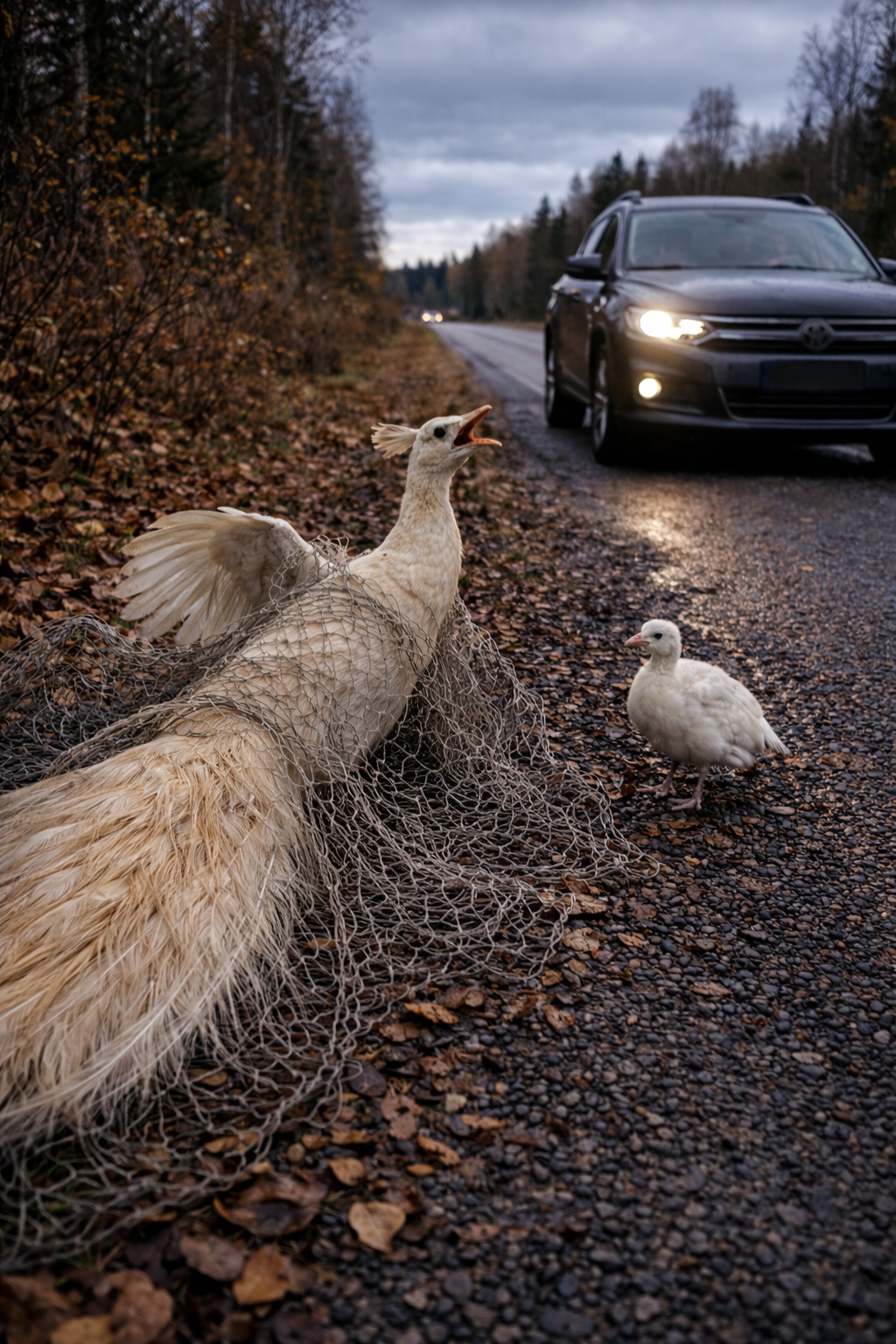
In the distance, a dark SUV appeared around a bend in the road.
The vehicle moved steadily along the highway until the driver noticed something unusual near the roadside.
At first, he wasn’t sure what he was seeing.
A white shape moved beside the gravel shoulder.
The man slowed down slightly.
As he got closer, the scene became clear.
It was a peacock.
And it was trapped.
The driver immediately realized the bird was tangled in something.
Beside it stood the small chick, still chirping loudly.
For a brief moment, the man hesitated.
Many drivers might have continued on their way.
After all, people often assume nature will take care of itself.
But this situation wasn’t natural.
The peacock wasn’t trapped by nature.
It was trapped by human waste.
And that meant someone needed to help.
Without thinking twice, the man slowed his vehicle and carefully pulled over to the side of the road.
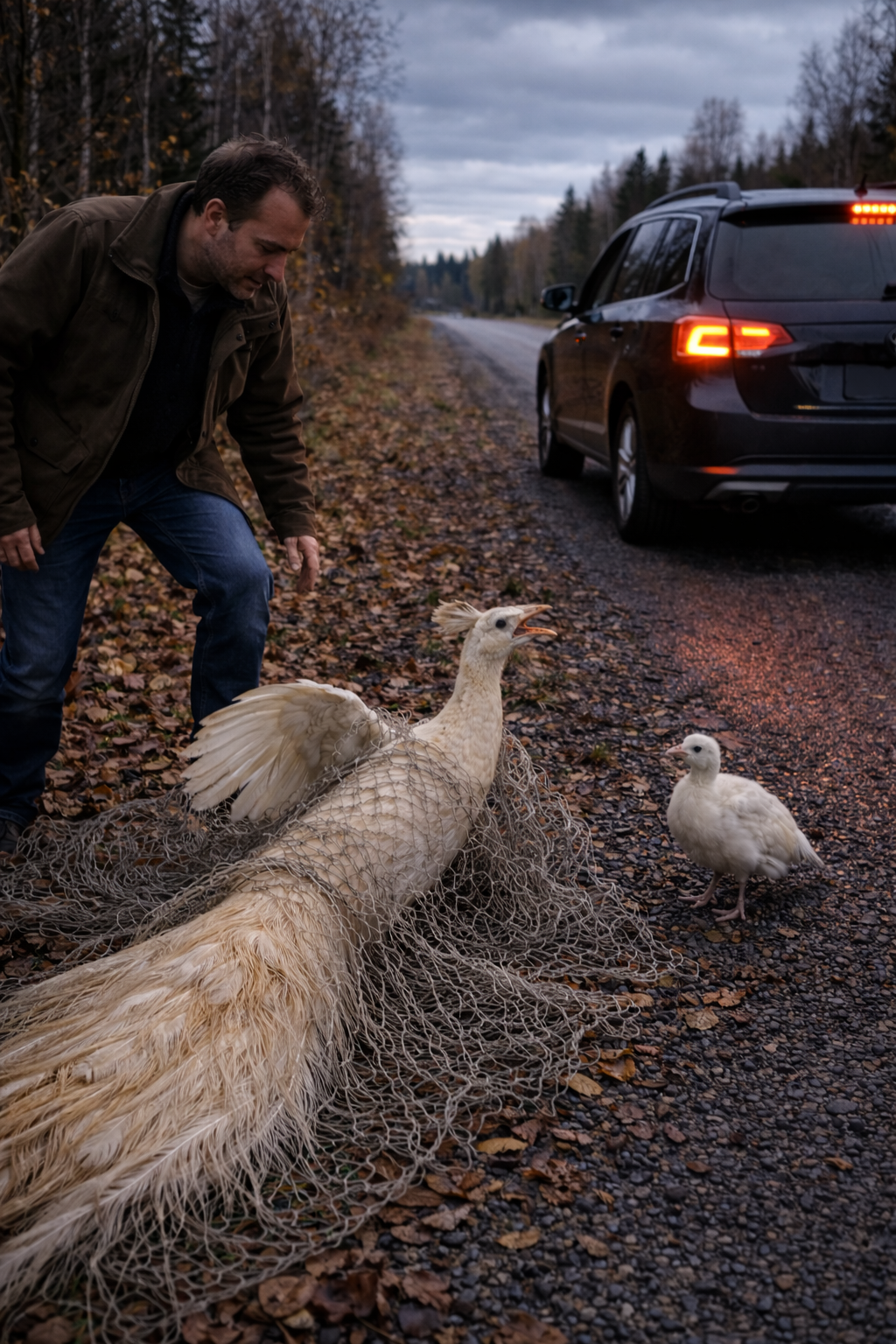
The SUV’s hazard lights blinked quietly as the man stepped out of the car.
He looked around the peaceful road and then slowly walked toward the struggling bird.
The chick noticed him immediately.
It stepped back slightly but didn’t run away.
The trapped peacock looked exhausted.
Its wings moved weakly as the man approached.
He crouched down and examined the fishing net.
The net was wrapped tightly around the bird’s feathers and wings.
Pulling it off by hand would likely hurt the peacock.
So the man reached into his pocket and pulled out a small knife.
Very carefully, he began cutting the tangled threads.
One strand at a time.
He moved slowly to avoid scaring the bird.
The chick stood nearby, watching every movement.
The peacock remained surprisingly calm, almost as if it understood the man was trying to help.
After several careful cuts, part of the net loosened.
The bird’s wing moved slightly.
Encouraged, the man continued cutting the remaining strands.
The rescue took several minutes.
Finally, the last piece of net snapped free.
The tangled fishing net fell onto the gravel beside them.
For the first time in what must have felt like hours, the peacock was free.
The bird slowly lifted its wings and stretched them carefully.
Its long white feathers moved gracefully in the wind.
The peacock stood up, still tired but no longer trapped.
The small chick immediately ran closer to its parent.
The man stepped back slowly, giving the birds space.
For a quiet moment, they all stood there on the side of the peaceful forest road.
The danger was over.
The peacock looked around the forest.
Then it gently began walking toward the trees with the chick following closely beside it.
Within moments, the two birds disappeared into the safety of the forest.
The man watched them go.
A quiet smile appeared on his face.
He then picked up the old fishing net from the ground.
Something so small had almost caused a tragedy.
One piece of trash had nearly taken the life of a beautiful wild animal.
Yet one simple decision had saved it.
Sometimes helping doesn’t require special skills or heroic strength.
Sometimes it simply means stopping your car and choosing to care.
This small act of kindness on a quiet autumn road reminded us of something important.
Wild animals face many dangers every day.
But many of those dangers are created by humans.
Plastic waste, fishing nets, and trash left behind can easily become deadly traps for animals.
A careless action can cause harm.
But a compassionate action can save a life.
On that quiet road surrounded by tall trees and falling leaves, one man chose compassion.
Because of that decision, a beautiful white peacock and its tiny chick were able to return safely to the forest.
Sometimes the smallest moments of kindness make the biggest difference.