The Moment on the Empty Road
The countryside road stretched quietly through miles of dry grass fields and scattered trees.
It was the kind of road where traffic was light and long stretches of asphalt passed without seeing another vehicle. The afternoon sun hung high above the fields, casting warm light across the landscape.
For most drivers, the road offered a calm and peaceful drive.
For Mark Wilson, it was simply another trip home after finishing work in a nearby town.
His dark sedan moved steadily along the two-lane road while soft music played quietly from the car speakers.
The countryside looked calm.
Wind moved gently through the tall dry grass while birds occasionally crossed the sky above.
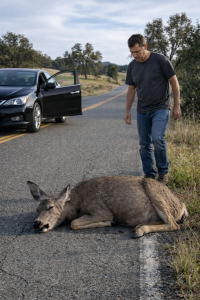
But as Mark rounded a slight curve in the road, something unusual appeared near the roadside.
At first, he thought it might simply be an animal resting in the grass.
But as he looked closer, he realized something wasn’t right.
A deer was lying on the edge of the asphalt.
The animal wasn’t moving.
Mark immediately slowed down.
Wild animals sometimes wander onto rural roads, but this situation felt different.
The deer looked weak.
Her body was lying awkwardly on the ground, and she seemed unable to stand.
Mark carefully pulled his car over to the side of the road.
The engine shut off, and the quiet countryside returned.
He stepped out of the vehicle and slowly approached the animal.
The deer was breathing heavily.
Her chest rose and fell slowly as she lay on the roadside.
Mark stopped several meters away to avoid frightening her.
Then he noticed something else.
The deer was pregnant.
Her body showed clear signs that she was carrying a fawn.
The situation suddenly felt far more urgent.
If the deer was weak or injured, the unborn fawn was also in danger.
Mark felt a deep concern.
He knew he couldn’t simply leave the animal there.
Carefully, he reached into his pocket and pulled out his phone.
Kneeling on the roadside, he searched quickly for the number of local wildlife rescue services.
Within moments, he was speaking with a dispatcher.
“I’ve found a deer collapsed on the side of the road,” Mark explained urgently.
“She looks pregnant and very weak.”
The dispatcher asked for the location while Mark described the quiet stretch of road.
“Stay a safe distance away,” the dispatcher advised. “We’re sending a wildlife rescue team.”
Mark remained nearby, watching the deer carefully.
The animal barely moved.
Her breathing remained slow and strained.
Minutes felt long as Mark waited.
The road remained mostly empty, and the quiet countryside seemed unaware of the delicate situation unfolding beside it.
Then, in the distance, flashing lights appeared.
A wildlife rescue truck approached along the road.
The vehicle pulled over near Mark’s car.
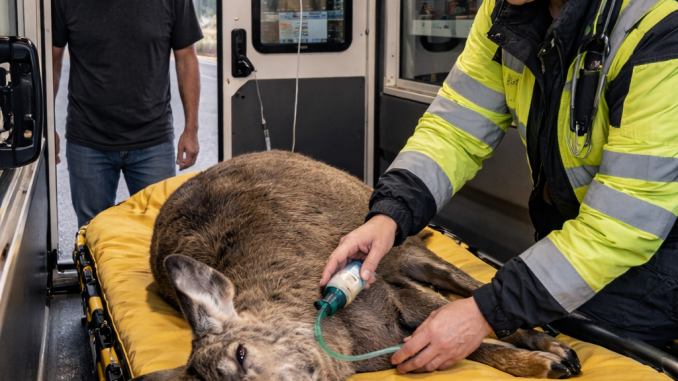
Two rescuers stepped out wearing reflective rescue jackets, followed by a veterinarian carrying medical equipment.
They moved carefully toward the deer.
Wild animals can easily panic when approached, so every movement needed to be calm and controlled.
One rescuer spoke softly while the veterinarian examined the deer from a safe angle.
“She’s exhausted,” the veterinarian said.
The team quickly prepared a padded animal stretcher designed specifically for wildlife rescues.
With slow and careful movements, they gently lifted the deer onto the stretcher.
The animal remained weak but calm as they supported her body.
The veterinarian continued checking her breathing and overall condition.
The rescuers worked efficiently, making sure the deer was secure and comfortable.
Mark watched quietly nearby.
He felt relief knowing professionals had arrived.
The deer was carefully carried toward the wildlife rescue vehicle.
Inside the vehicle, a soft medical stretcher had already been prepared.
The rescuers placed the deer gently onto it while the veterinarian continued monitoring her condition.
The doors of the ambulance vehicle remained open for a moment as the team completed final checks.
Mark stood beside the road watching the scene.
He had never expected his quiet drive home to turn into a wildlife rescue.
But sometimes the smallest decisions can make a difference.
If he had continued driving, the deer might have remained alone on the roadside.
The veterinarian stepped out briefly and nodded toward Mark.
“You did the right thing calling us,” she said.
Mark gave a small smile.
“I’m just glad someone could help.”
Soon the ambulance doors closed carefully.
The rescue vehicle started its engine and prepared to drive toward the nearest wildlife clinic where the deer could receive proper medical care.
As the vehicle slowly pulled away, Mark watched until the flashing lights disappeared down the quiet road.
The countryside returned to its peaceful silence once again.
But somewhere down the road, a rescue team was working to give a struggling animal another chance.
Sometimes helping doesn’t require special skills or training.
Sometimes it begins with something very simple.
Noticing.
Stopping.
And deciding that a life on the roadside deserves attention.
And on that quiet afternoon, one driver’s choice may have helped protect not just one life — but two