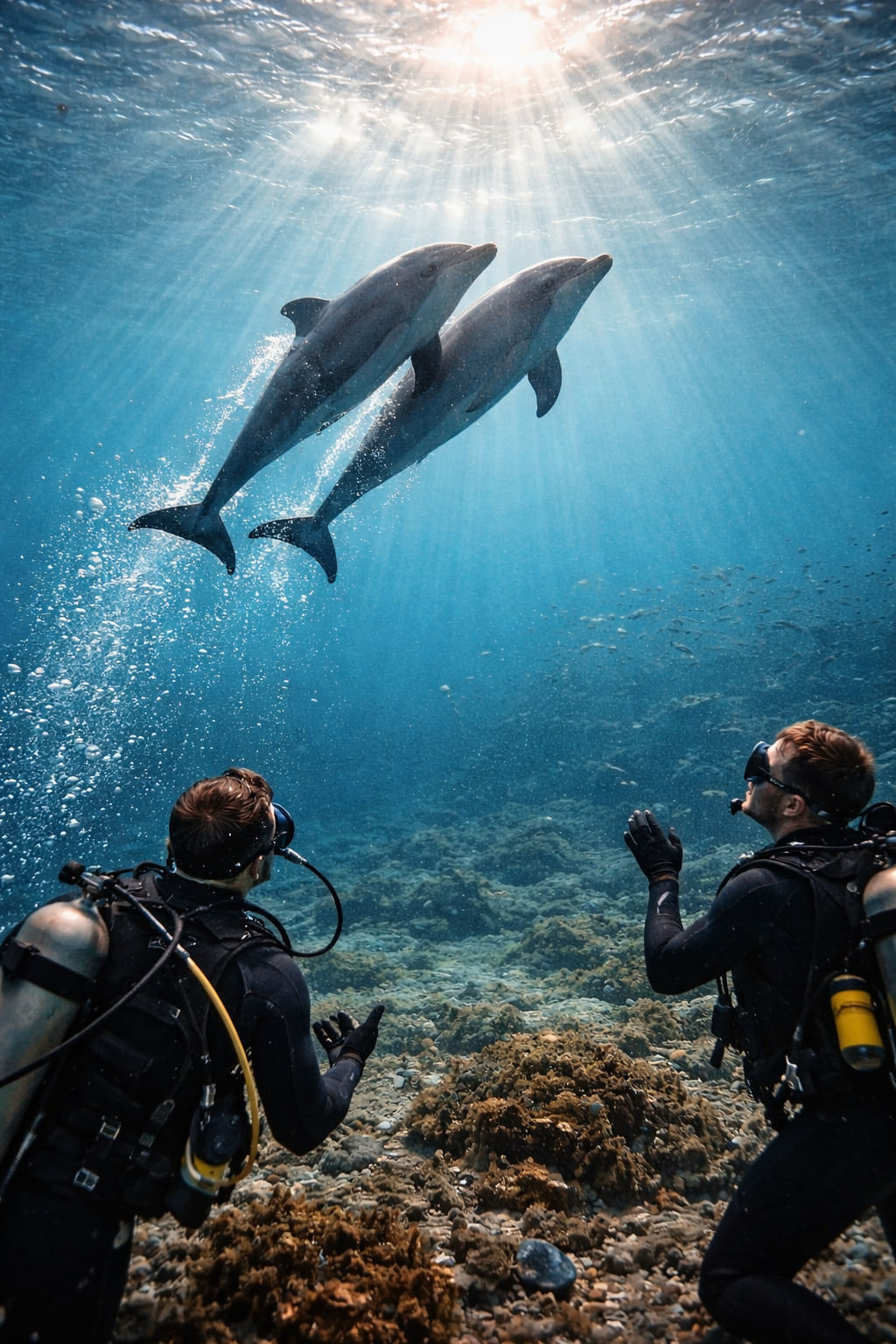
The Dolphin That Asked for Help
Far below the surface of the ocean, where sunlight slowly fades into deep blue water, life moves in a quiet and graceful rhythm.
Fish travel in shimmering schools, seaweed sways gently with the currents, and rays of light filter down from the surface like golden beams moving through the sea.
But hidden among this peaceful underwater world are reminders of a growing problem.
Human debris.
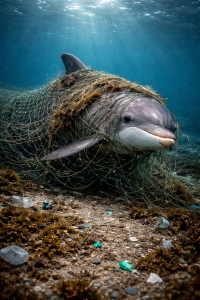
Old fishing nets, plastic ropes, and abandoned equipment sometimes drift slowly down toward the seabed, becoming dangerous traps for marine life.
On this particular day, near a quiet stretch of ocean floor covered with sand and patches of seaweed, a large dolphin struggled to move.
The dolphin’s body had become tangled inside an old fishing net.
Pieces of rope wrapped tightly around its fins and tail, while thick strands of algae-covered netting clung around its body.
The dolphin moved slowly, trying to swim forward.
But the net tightened each time it tried to escape.
Its powerful tail pushed against the water, yet the tangled ropes held it close to the seabed.
The dolphin could barely move.
Above, sunlight flickered softly through the ocean water.
Small fish swam past the scene without understanding the danger below.
For the trapped dolphin, time was becoming critical.
Then something appeared in the distance.
Another dolphin.
Dolphins are known for their strong social bonds and intelligence. They often travel in groups and communicate through whistles and clicks that carry across long distances underwater.
As the second dolphin approached, it noticed something unusual.
The trapped dolphin’s movements were slow and restricted.
The second dolphin swam closer.
It circled around the tangled net, observing carefully.
The situation was clear.
The dolphin was trapped.
The second dolphin moved closer, nudging gently near the net as if trying to help.
But the ropes were too strong.
The net could not be broken.
For a moment, the second dolphin paused, as if thinking.
Then suddenly, it turned and swam upward toward the surface.
Fast.
Powerful strokes of its tail pushed it through the blue water.
Bubbles trailed behind as the dolphin raced toward the light above.
Breaking through the surface, the dolphin emerged near a small diving boat floating calmly on the ocean.
Several scuba divers sat on the boat preparing their gear for a routine dive.
The dolphin began circling the boat.
Again and again it jumped partially out of the water, splashing loudly.
One diver noticed first.
“Look at that dolphin,” he said.
The animal continued jumping and circling, almost as if trying to get their attention.
At first, the divers thought it was simply playful behavior.
But the dolphin didn’t leave.
Instead, it kept swimming close to the boat, splashing and diving again.
Something about the behavior seemed unusual.
One of the divers spoke up.
“It looks like it wants us to follow.”
Curious, the divers quickly finished preparing their equipment.
Moments later, they entered the water and began descending into the blue depths.
The dolphin waited nearby.
Then it began swimming downward.
The divers followed.
As they reached deeper water, the ocean floor slowly came into view.
And then they saw it.
A dolphin trapped in a large fishing net.
The ropes were tangled tightly around the animal’s body and fins.
The trapped dolphin moved slowly, clearly exhausted.
The divers immediately understood the situation.
Abandoned fishing gear is one of the most serious threats to marine animals.
Nets left drifting in the ocean can trap dolphins, turtles, and countless other species.
Working carefully, the divers approached the dolphin slowly to avoid causing additional stress.
One diver pulled out a cutting tool.
The other gently held the net away from the dolphin’s body.
The second dolphin circled nearby, watching closely.
Slowly, carefully, the diver began cutting through the thick ropes.
One strand at a time.
The net loosened slightly.
More cuts followed.
Each movement required precision to ensure the dolphin wasn’t injured.
Finally, the last strands of net fell away.
The dolphin moved its fins freely for the first time.
It swam slowly forward.
Then it turned and circled once around the divers.
Almost as if acknowledging the help.
Nearby, the second dolphin swam closer.
For a moment, both dolphins hovered in the water together.
Then they began swimming upward toward the bright surface.
Side by side.
The divers watched quietly as the two dolphins disappeared into the sunlight above.
The ocean returned to its peaceful rhythm.
But the moment left a lasting impression.
Sometimes the ocean reminds us how intelligent and connected marine life can be.
And on that day, one dolphin showed something remarkable.
It recognized danger.
It searched for help.
And it found a way to bring rescuers exactly where they were needed.
A powerful reminder that even beneath the waves, cooperation and compassion can make all the difference.