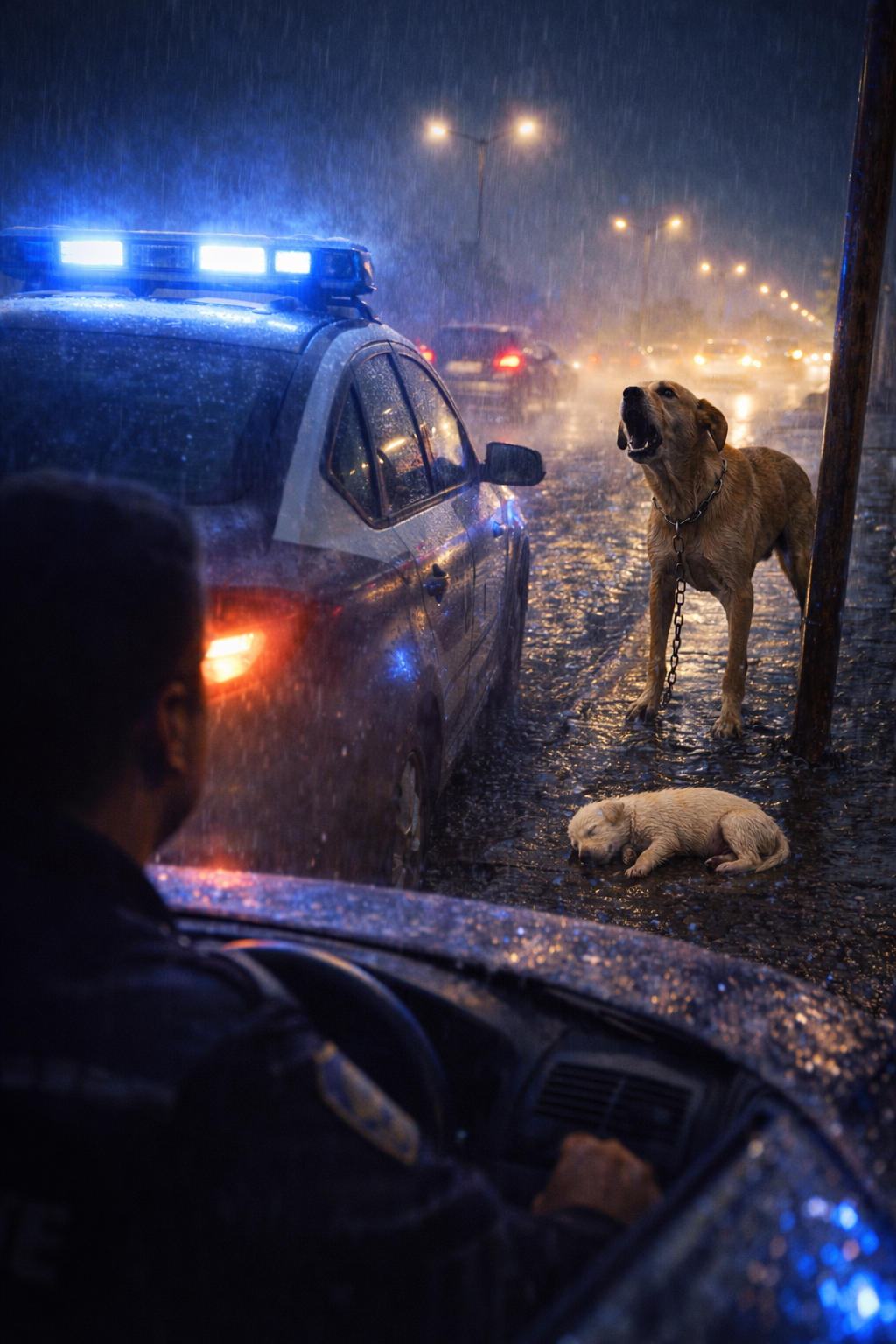
Rain had been falling for hours that night.
The kind of rain that slowly fills the streets with reflections of yellow streetlights and makes the sound of passing cars echo through the dark. Drivers hurried along the road, windshield wipers moving back and forth as they tried to see through the steady downpour.
For most people, it was just another rainy night.
But on the edge of the road, something very different was happening.
Next to a tall metal pole stood a thin brown dog, soaked from head to tail. Rainwater dripped from its fur, and its paws were planted firmly on the wet pavement. Around its neck was a metal chain tied tightly to the pole.
The dog couldn’t leave.
And it wouldn’t stop barking.
Again and again, the sound echoed across the road. Each bark was loud, urgent, almost desperate.
Cars passed by without slowing down. Their headlights briefly illuminated the scene before disappearing into the darkness.
To anyone inside those cars, it probably looked like just another stray dog reacting to the storm.
But the dog had a reason.
Only a few feet away from the pole, lying on the cold pavement, was a small puppy.
The puppy’s light-colored fur was soaked from the rain. It lay curled up, barely moving, its tiny body pressed against the ground as if trying to protect itself from the cold.
The little animal looked exhausted.
Too tired to stand.
Too weak to cry.
The older dog stood watch nearby, pulling slightly against the chain around its neck, barking toward every passing vehicle.
The message was clear.
It needed help.
Minutes passed.
The rain continued falling. Water streamed along the edges of the sidewalk and pooled around the cracks in the asphalt.
Drivers stayed inside their cars, warm and dry.
Some noticed the barking dog but continued driving.
Others didn’t notice at all.
Still, the dog kept barking.
Every time headlights approached, the dog barked louder, as if hoping that one of those cars would finally stop.
The puppy remained still on the pavement.
Then, after what felt like a very long time, something changed.
Down the road, a police patrol car was moving slowly through the rain. Its headlights cut through the darkness, reflecting off the wet road ahead.
Inside the vehicle, the officer behind the wheel focused on the quiet nighttime patrol.
Rain tapped steadily against the windshield.
Suddenly, the officer heard barking.
At first it sounded distant, almost lost in the noise of the rain. But as the patrol car moved closer, the sound grew louder.
It wasn’t ordinary barking.
It sounded urgent.
The officer looked toward the side of the road and noticed a dog tied to a pole on the sidewalk.
The dog was barking directly toward the street.
Something about the scene didn’t seem right.
The officer slowed the patrol car.
As the vehicle moved closer, the flashing reflections of streetlights revealed something else on the pavement.
A small shape near the dog.
The officer pulled the patrol car to the side of the road and stopped.
Blue emergency lights flickered softly, reflecting across the rain-covered asphalt.
The officer stepped out of the car and immediately felt the cold rain soaking into his uniform.
The dog barked again.
But this time the sound was different.
Less panic.
More urgency.
As the officer approached the pole, he quickly understood why.
There on the ground was the small puppy.
The puppy was soaked and shivering, its tiny body barely moving in the rain.
Without hesitation, the officer knelt down on the wet pavement.
The cold water soaked through his uniform, but he didn’t pay attention to it. Carefully, he reached down and gently lifted the small puppy from the ground.
The puppy felt incredibly light.
Its small chest moved slowly as it breathed.
The officer quickly checked the puppy and realized that although it was weak, it was still alive.
Nearby, the chained dog had stopped barking.
Instead, it watched quietly.
Its eyes followed every movement as the officer carefully held the puppy in his hands.
The officer stood up and moved toward the patrol car.
Inside the vehicle, he found a clean cloth and wrapped the tiny puppy to keep it warm.
The puppy remained quiet, resting in the cloth as the officer protected it from the rain.
Next, the officer turned back toward the chained dog.
The chain around the dog’s neck was old and tightly wrapped around the metal pole. Using tools from the patrol vehicle, the officer carefully loosened and removed it.
Within moments, the dog was finally free.
For a second, the animal stood still.
Then it walked slowly toward the officer and looked up at him.
There was no barking now.
Just calm.
The officer opened the patrol car door and carefully placed the wrapped puppy inside the vehicle where it would stay warm.
The older dog followed and sat beside the car, watching closely.
It was almost as if the dog understood that help had finally arrived.
Soon, both animals were safely inside the patrol car.
The heater began warming the inside of the vehicle while the rain continued falling outside.
The officer started the engine and slowly drove away from the roadside.
The quiet hum of the car replaced the sound of rain.
Inside, the small puppy rested safely in the cloth, its breathing steady and calm.
Next to it sat the older dog, alert but peaceful.
For the first time that night, everything felt safe.
Sometimes the most important moments happen quietly.
There were no crowds watching.
No cameras capturing the moment.
Just one person who decided to stop and pay attention.
The dog had barked for a long time in the rain, hoping someone would notice the small life lying on the cold pavement.
Eventually, someone did.
And that decision changed everything.
Stories like this remind us that compassion doesn’t always appear in dramatic ways.
Sometimes it begins with something simple.
A sound that catches someone’s attention.
A decision to slow down.
A moment of kindness in the middle of an ordinary night.
And sometimes, the ones asking for help the loudest are the ones who cannot speak at all.
But if someone is willing to listen, even a desperate bark in the rain can be heard.
And when it is, it can make all the difference.